This website uses cookies to analyze traffic.
By clicking “I agree” you consent to the processing.
Do you want to train with us? Do you want to race with us?
Don't hesitate to contact us.
Marcel Kindl – a man who conquers Half Ironman at 50 like a young athlete.
📅 7. 11. 2025✍️ MAMA3 Club
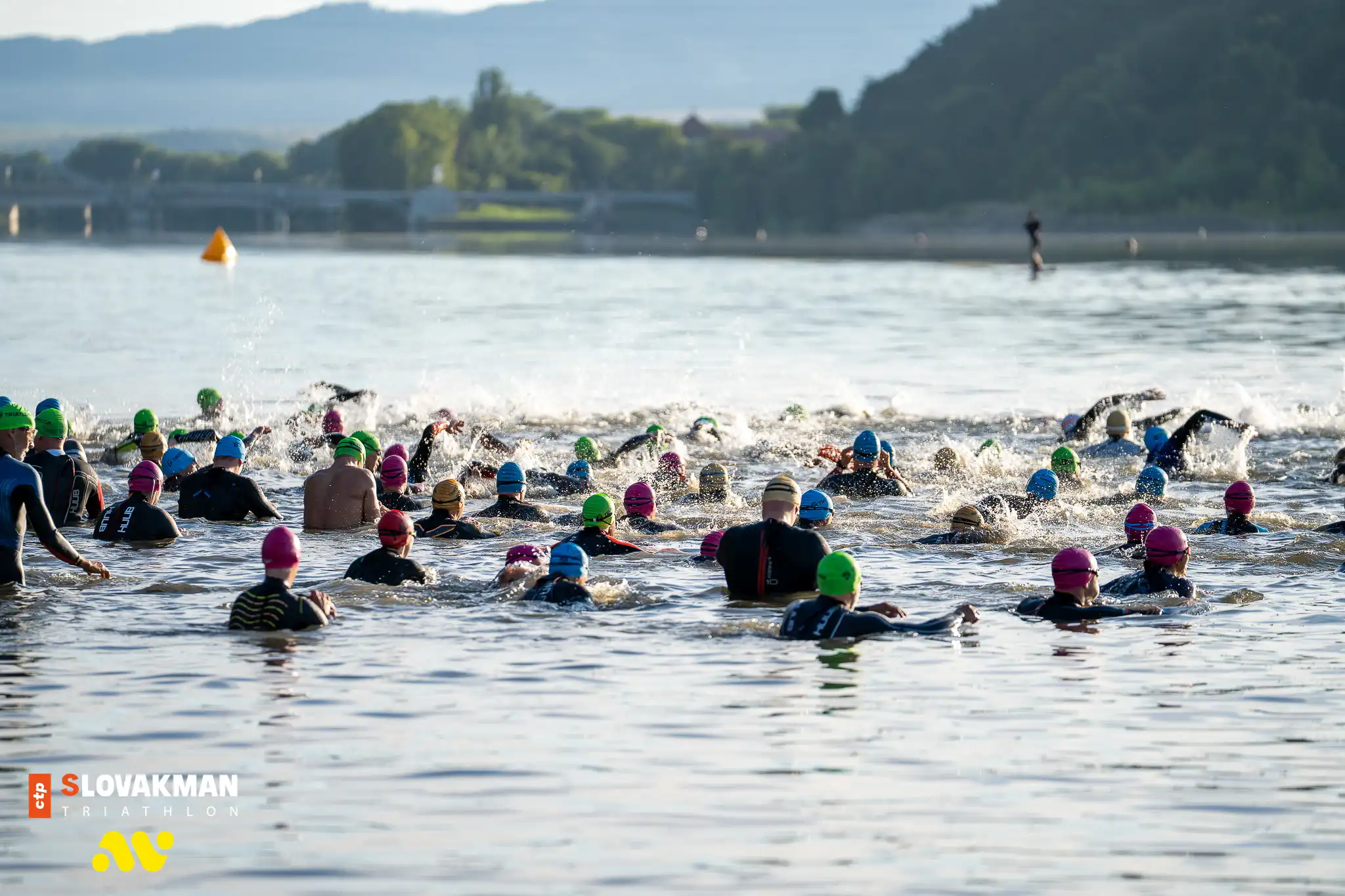
Marcel Kindl, born in 1974, is living proof that age is just a number. This year, he successfully completed the Half Ironman at the prestigious Slovakman event, achieving an impressive time of 5:19:39. As an excellent swimmer, he performed brilliantly in the opening discipline – finishing as the 17th fastest among all participants. We talked with him about his preparation, motivation, and race experiences in the following interview.
Marcel, congratulations on your excellent performance at Slovakman!
Thank you very much, but it wasn’t such an amazing performance within the triathlon community — more of a personal success for me as an amateur.
When and how did the idea to try triathlon first come to you?
The idea of doing triathlon came to me several times. I grew up in a sports-oriented family — sport and movement are in my blood. Until the age of 17, I was a competitive modern pentathlete, which includes swimming, shooting, running, fencing, and horse riding. I had to stop because of health issues and focused more on my studies.
When I was 20, I tried triathlon for a short period, but it only lasted a few months. Then came family life, small children, and no time for active training. In my thirties, I suffered a knee injury, and by 35 I had to quit football completely. All my uncles, as well as my father, had run marathons, so I always assumed I would do one someday too. But work, injuries, and a bit of laziness were against me.
When my children got older, I started using their training time to go for runs myself. Around my 40th birthday, I bought a bike and started doing a bit of triathlon again. After about five years, my knee pain returned, so I stopped running and started gaining weight, though I kept cycling recreationally.
I tried everything for my knee — ointments, supplements, even physiotherapy. My last restart came about a year and a half ago when, somehow, the pain disappeared. Since then, I’ve been carefully progressing again. And that little spark of hope for a marathon is alive once more — maybe even for an Ironman someday.
How do you remember your first triathlon – where was it, and how would you compare it to Slovakman 2025?
I have to dig deep into my memories for that one. My very first triathlon was about thirty years ago, so there are definitely some differences. At that time, there was no internet, and getting any information was much harder. I found a list of triathlon races posted on a bulletin board at the Sports House in Pasienky. I chose the closest one — in Senec — with the Olympic distance.
As a student, I didn’t have much money, and I had to arrange transportation on my own — by bike. I didn’t take training too seriously. I went swimming a few times at Pasienky, went running a few times, but cycling was completely new to me. It was clear it wouldn’t be my strong suit. I set off for my first race, of course, by bike — about 35 kilometers to Senec. With a strong headwind and the feeling that I was running late, I pushed pretty hard, and by the time I arrived, I was already exhausted.
I didn’t know much about nutrition; I only brought water for the bike leg. I got out of the water somewhere in the first third, which was pretty good. Then came my death — drafting wasn’t allowed, and everyone was passing me. After 40 km, I barely made it to the transition area. At the aid station, I stopped and started stuffing myself with everything they had — bananas, oranges, cookies, sugar. The other competitors just grabbed something and kept running. I was there for at least three minutes. 😊 Even the volunteers started telling me to move on.
Eventually, I started running, and surprisingly, I felt good — I passed quite a few people. After crossing the finish line, I waited for the results to be posted (they weren’t online back then). To my shock, I found out I was disqualified — and I didn’t know why. Filing a protest cost 20 korunas, and I didn’t have that. But I went to ask anyway. Some guy brushed me off — later I learned he was the chairman of the triathlon federation — and told me there was nothing to protest because even the first woman had passed me, and I got a penalty for drafting.
In my fog during the bike ride, I hadn’t noticed anything like that. I wasn’t holding onto anyone’s wheel — everyone was just flying past me. But maybe when they overtook me, I didn’t slow down enough, and within the time window, I didn’t keep the required distance. I didn’t realize that was my responsibility. I thought, “They’re the ones overtaking — let them work!” And they kept overtaking me. 😊
It was disappointing and discouraged me from continuing with triathlon for a while. That memory still echoed a bit during Slovakman — I made sure to keep longer distances and pay attention to drafting, especially since a lot of cyclists were overtaking me again.
When I compare triathlon back then and now, it’s clear technology has advanced and become more accessible, even for amateurs. Information about training methods is also much easier to find. I prepared for Slovakman systematically for almost a whole year. For example, smartwatches are now a standard — back then, we measured our pulse on the wrist and had to stop to do it. During the race, I could constantly monitor my heart rate and pace to avoid overpacing.
Bikes have changed the most — they’re faster and more comfortable now. And last but not least, nutrition is completely different. At Slovakman, using gels and isotonic drinks, I never hit a sugar or salt deficit. And as for the feeling during the race — I don’t even need to explain the difference. :)
Based on the results, your swimming is clearly under control – 17th place overall is an excellent performance. Have you been swimming for a long time, or is this the result of systematic training?
I’ve had the technique since my youth, which is a big advantage compared to triathletes who started later. I used to swim competitively for six years as part of modern pentathlon — the body remembers. Actually, I hardly train swimming at all now, maybe once a week at most.
In the future, I should increase my swim volume to prepare for longer triathlons and build a solid endurance base, which will help me lower my heart rate and save energy for the other disciplines.
Which discipline gives you the most joy, and which one is, on the other hand, your weaker side?
I’d say all my disciplines are weak. As the saying goes — if you can’t swim well, bike well, or run well, try triathlon. 😊 What matters most is that I truly enjoy the movement itself — swimming, cycling, and running.
Running is probably my weakest, partly because of a few extra kilos, so I plan to focus more on it in the near future. Back in my youth, I used to be a solid runner.
What did your training plan look like before Slovakman? You’re combining training with work and family life – how do you manage it time-wise?
The book “The Triathlete’s Training Bible” by Joe Friel has been a huge help in planning my training — I highly recommend it. I first focused on building my aerobic base and gradually losing weight. My long-term goal was to lose 1 kg per month, which I managed to do — by summer, I had lost 8 kilograms.
Running was my biggest struggle. Last summer, at the start, I couldn’t even run 5 kilometers without stopping. So, I started with short runs and breaks, then moved on to 4 km easy runs at about 7 min/km pace. Gradually, by winter, I increased it to continuous 7–8 km runs. During the winter, I also include my favorite sport — cross-country skiing (skating style). Unfortunately, near Bratislava we don’t have great conditions, so I can only do it a few times a year.
In spring 2025, I began adding more intensity to my sessions. My target was to train 7–8 hours per week, but realistically, I averaged about 5 — still enough. Like every amateur with a family and a job, I’m constantly fighting for time, and I don’t want to train at the expense of my family. Luckily, my kids are already older, so I don’t have to drive them to after-school activities like a few years ago.
I try to use my time efficiently — I often commute to work by bike, rides of around 30–40 km. Sometimes I stop at the swimming pool on my way home. On weekends, I try to go swimming with my wife — luckily, she enjoys it too — and whenever possible, we go cycling together along the Danube or through the forest trails.
I only got to longer rides (over 80 km) about two months before the race. As part of my preparation, I did some control tests, either during training or by entering smaller races. The first test was the ČSOB Half Marathon in April 2025. Unfortunately, two weeks before the race, I got a bad flu, so I ran it just as support for a friend — it turned into a training session rather than a race.
My biggest worry was running after a long bike ride, since I had only done sprint triathlons before — jumping to a half-Ironman is a big leap. So, I looked for an Olympic triathlon (1.5 km + 40 km + 10 km) about a month before Slovakman. There aren’t many around here, so I chose Stará Myjava, scheduled for July 13, 2025. However, due to poor water quality, they changed it to a duathlon — a perfect chance to test my running legs after biking.
During the race, I had terrible luck — two flat tires. After the second one, I didn’t have another spare tube and was ready to give up. Then, out of nowhere, a coach stopped by, saw what happened, and without hesitation gave me his own bike. His trainee started panicking that I might get disqualified for that. I didn’t care — my goal was to test my run off the bike. I cautiously made it to transition as the very last competitor, where an official stopped me to ask if I had swapped bikes. I said yes, and she said I was disqualified. I told her, “That’s fine, but I’ll finish the race anyway.” She smiled and said okay.
I managed the run about as I’d expected — just under a 6 min/km pace. I’m very grateful to that coach — he really helped me out. If only there were more people like him. That was truly luck in misfortune.
The final test before Slovakman was a simulated race eight days before the event. The plan was to go about 70–80% of the half distance, including the same nutrition and hydration strategy I’d use on race day. I biked to Rusovce, swam 1.3 km at a 1:55/100m pace, then got on the bike, did 60 km on the Petržalka dam and back home to Ružinov. My average speed was 31 km/h with a heart rate around 135 bpm. I don’t have a power meter, so I pace myself by heart rate to make sure I don’t burn out on the longest discipline.
At home, I changed and ran 16 km. The gels and isotonic drink worked perfectly, which was a relief. The last test went smoothly, so during the final week before the race I took a proper rest, doing just one light session for each discipline.
Did you experience any crises or moments during your preparation when you felt like giving up?
Not giving up, no — but I did have doubts about whether I could actually handle it. I knew I could complete each discipline on its own, but the question was what would happen when I stacked them one after another. I did a series of control tests along the way, and since I managed to meet them all, I eventually believed I could do it.
How did being a member of the MAMA3 club help you — in terms of motivation, training, or overall support?
I met Matej about a year and a half ago. At that time, I wasn’t actively doing triathlon — just cycling occasionally — but I was interested in the sport. Matej and I often talked about his current successes and setbacks. And as everyone knows, he’s really passionate about triathlon, and that enthusiasm probably inspired me to give it another try, despite my concerns about knee pain while running.
Once it became clear that I wanted to get back into triathlon, I joined the club for this season. In the meantime, I realized that the guys here are great — it’s basically a relaxed group of sports enthusiasts. Everyone trains in the way that suits them best; whoever wants to can sometimes train together or just meet up and cheer each other on at races.
How did you experience the race itself — the atmosphere, the transitions between disciplines, and the final running segment?
Before the race, I naturally had a lot of respect for the challenge ahead. I must say, the organization was absolutely top-notch. When picking up my race number, I happened to be standing in line right in front of Petr Vabroušek. To me, he’s a true triathlon legend — and such a genuinely kind person with a life philosophy I really relate to. We shook hands and even shared a quick laugh, which put me in a great mood before the race.
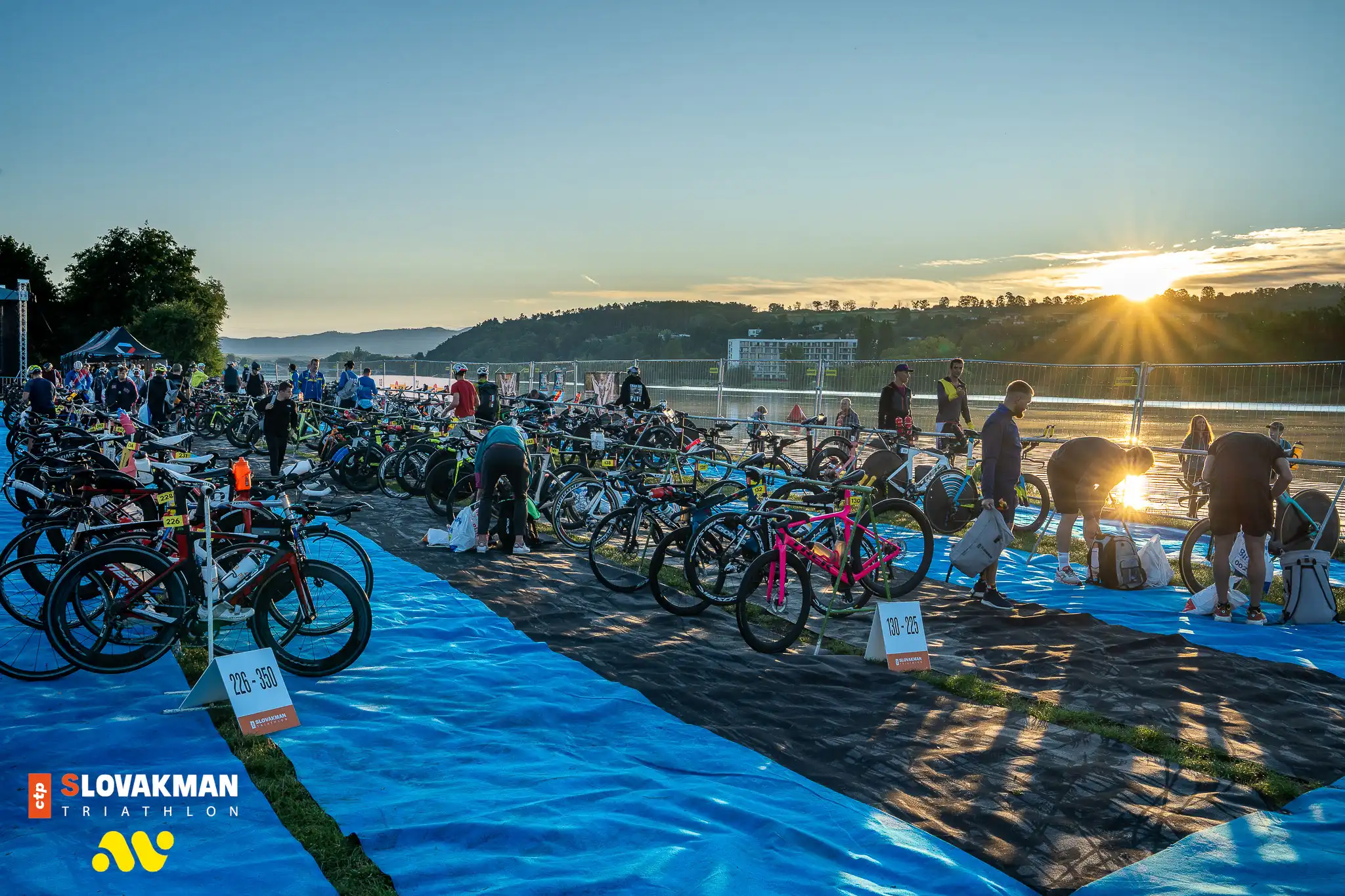
Despite that, my first transition didn’t go well. Looking back now, I can smile about it. I came out of the water clearly disoriented and tired from the swim, and I grabbed a transition bag with the wrong number. I opened it — and it wasn’t my stuff. So I put it back and started searching for my bag. In all the confusion, I ended up grabbing the same wrong bag again, convinced it was the right one — and I got really annoyed when I realized that someone else had put their things into my bag. 😊 Then it hit me — I was number 197, not 179, which I was holding in my hands. I’m confident that next time I won’t lose two minutes like that again.
The second transition went smoothly, and I had no issues switching to the run. I started a bit too fast. After 2 km I slowed down to about 5:35/km, and by the 10th kilometer I was struggling to keep around 6 minutes per kilometer. By the 15th kilometer, my leg muscles — especially the quads — started to stiffen, and it was a real fight until the end. But on the last kilometer, I somehow managed to dig deep and pick up the pace again.
Which moment during the race stuck in your memory the most?
There were several. First, during the swim, I kept getting “grabbed” by underwater plants — it was quite unpleasant. I wasn’t prepared for that, but of course, the conditions were the same for everyone. An interesting moment happened during the run, about halfway through, when I caught up with another runner. He tried to keep up with me and said he didn’t know why, but he was having cramps and didn’t know what to do, yet he wanted to finish. I felt sorry for him, so I slowed down a bit to stay with him. Since there was still a long way to go, I advised him to alternate between walking and running. In the end, he finished about half an hour after me, and I felt good about that. Of course, I clearly remember the feeling of relief when I crossed the finish line — that I had managed it and finished safely.
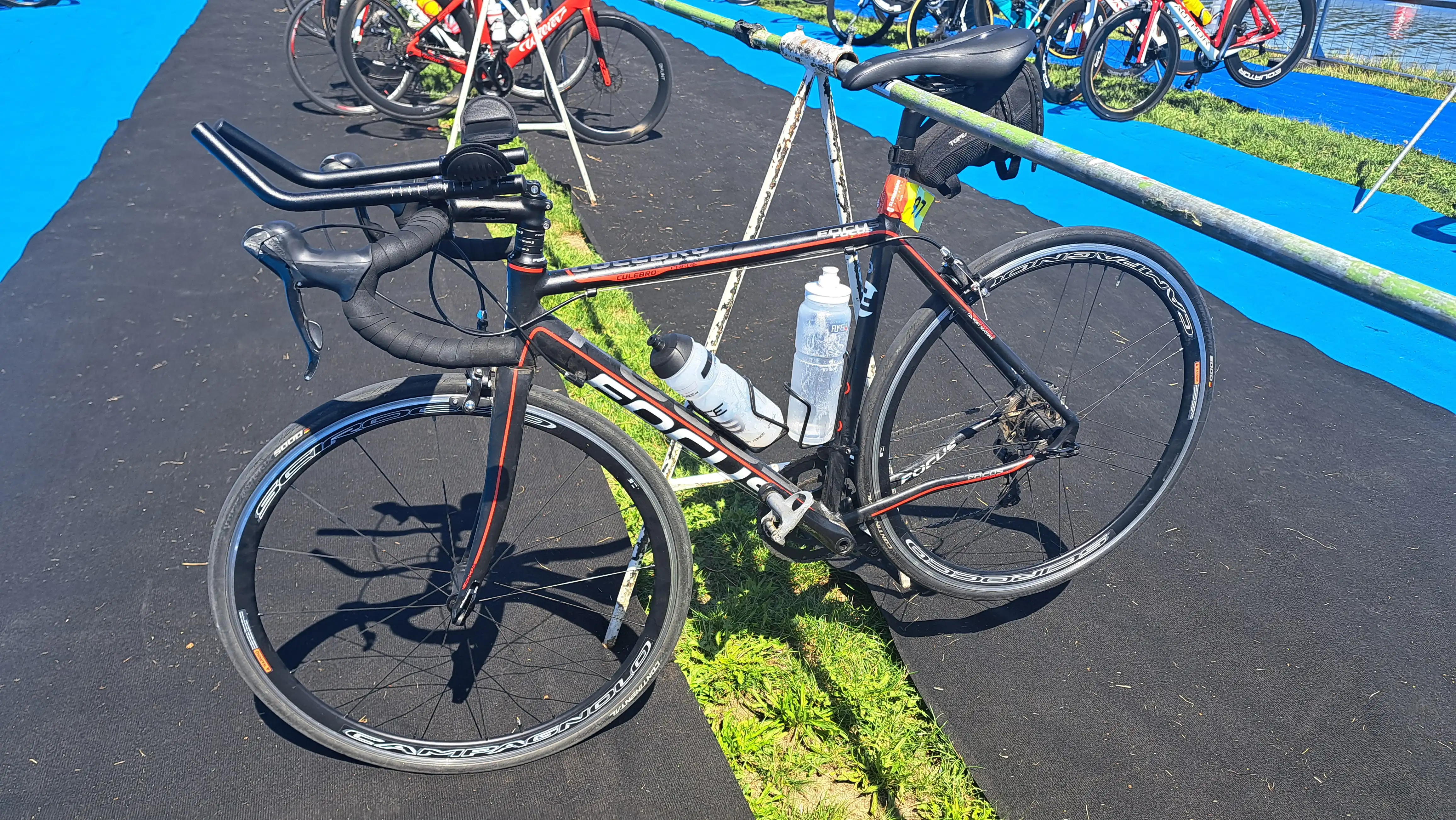
I also couldn’t help but smile at the sight of my €700 bike standing in transition surrounded by bikes that cost several times more. But it served me really well — I rode on average 3 km/h faster than I expected.
The time of 5:19:39 is truly excellent. Did you have a set goal beforehand, or was it one of those days when “everything just clicked”?
Based on my test milestones and what I had expected, it really turned out to be one of those days when everything just clicked. The weather was perfect — almost no wind on the bike, a beautiful 17 to 20 degrees Celsius. Even during the run, it wasn’t too hot, only a bit toward the end.
At the start, I told myself that if I finished under six hours, I’d be happy. During the race, I realized it might actually be under 5:30, and while running, I started calculating whether I could make it under 5:20. So for me — full satisfaction and great joy.
After such a performance, you definitely deserve some rest — but knowing triathletes, we’re guessing you already have another goal in mind. Where is your motivation headed next?
This race was quite a load on the body, even though I didn’t realize it right away. I didn’t have sore muscles and was back to light training after three days. But two weeks later, at the Olympic triathlon in Žilina, I completely burned out and was just happy to finish. I couldn’t perform at all, and my 10 km run was slower than my half marathon at Slovakman. At this age, recovery definitely takes longer, and that’s something to keep in mind.
My goal remains to complete an Ironman — but above all, to stay active and enjoy it. I’ve postponed the Ironman until 2027 for now. I don’t want to push an unprepared body through 12 hours of effort; I’d rather train properly and aim to go under 11 hours. I’ll adjust my 2026 preparation and training accordingly — I need to build the necessary endurance. Of course, everything depends on my family, work, and health — I’m not going to force anything. For 2026, my goal is to finish a Half Ironman in under 5 hours.
What would be your message to people aged 40+ or 50+ who are hesitating and wondering if it still makes sense to start doing triathlon?
Absolutely yes — even for those who haven’t been active before. By combining different sports, you spread the load across various muscle groups, which reduces the risk of injury or overuse of muscles and tendons. It’s definitely better than just running. Alternating between sports also gives your body more time to recover.
For me, running every third day works well. In between, I don’t have to sit around — I can go cycling or swimming instead. But it’s up to each person: some do sports just for joy, while others need a bit of competition as spice. Maintaining fitness certainly contributes to a more active life at an older age. It can also be nicely combined with family time — turned into trips or shared activities. Such movement together with your partner definitely helps create a more harmonious relationship.
Marcel’s story is proof that with determination, patience, and the right mindset, you can achieve anything — regardless of age or past injuries.
Behind every time, number, or result are countless hours of hard work, self-discipline, and moments when you simply don’t feel like doing it. But it’s those days that truly matter.
Marcel shows that even with a job, family, and responsibilities, you can always find time for yourself — and move forward step by step.
It doesn’t matter where you are today. What matters is where you want to go.
If you’re looking for motivation, support, and a community of people who will lift you up, join MAMA3.
For us, it’s not just about the results — it’s about the journey that leads to them. And just like Marcel, you can discover that limits exist only in your mind.